

You may first notice that your lipstick no longer sits as neatly, that the outline of your lips is softer, or that your upper lip seems to disappear a little when you smile. Perhaps you miss the definition you once had, but have no wish for noticeably fuller lips.
These concerns deserve a careful explanation. Changes in the mouth can involve the lips themselves, the skin around them and the tissues beneath. Understanding how those parts work together helps us decide what treatment could usefully achieve.
At Aesthetic Health in Leeds, our approach begins with diagnosis. We look at what has changed, what matters to you and what you want to preserve, then prescribe a plan that respects your natural features and expression.
Understanding the red lip and white lip
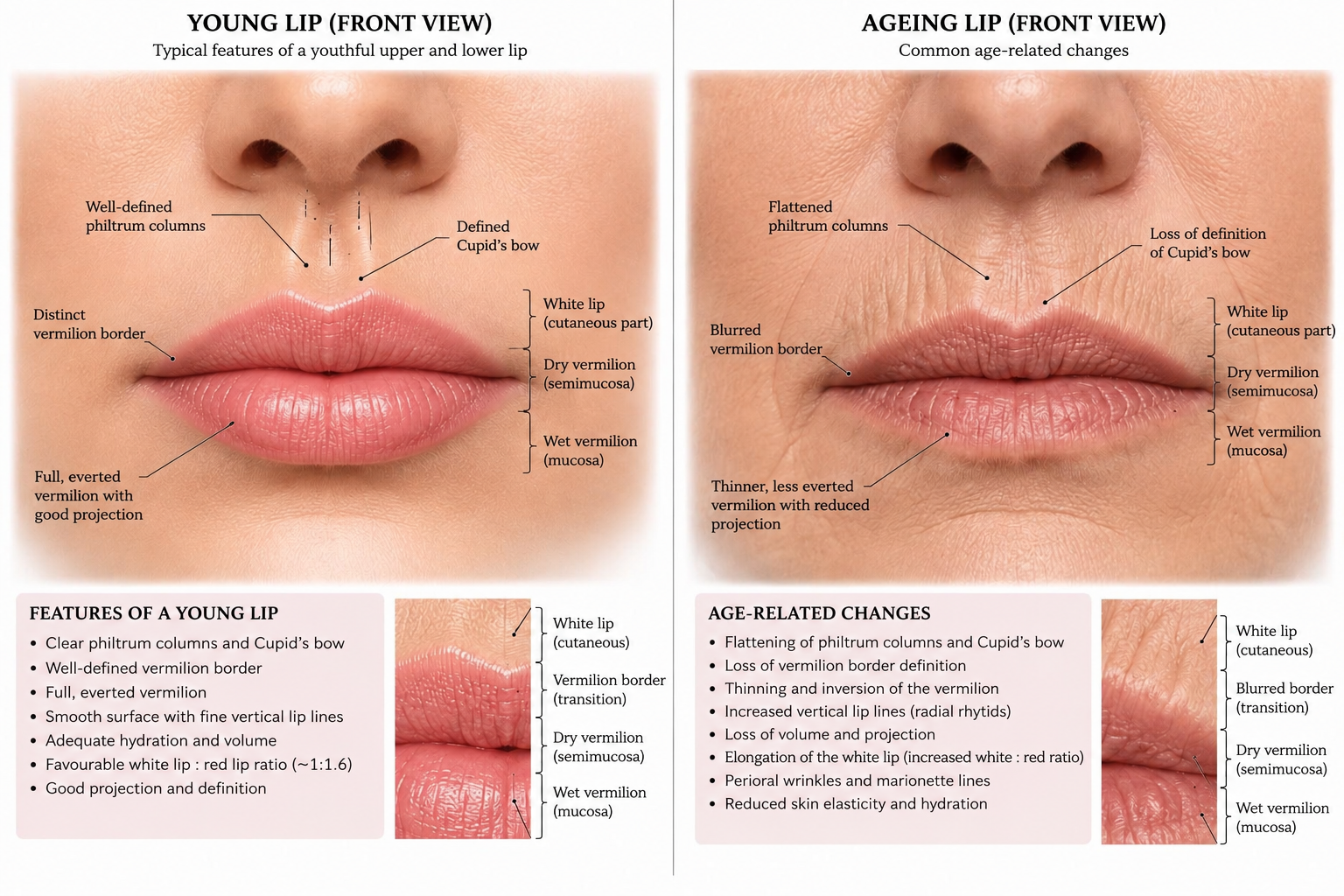
The pink or red part of your lips is called the vermilion. Its outline is the vermilion border. The two peaks in the centre of the upper border form the Cupid’s bow, with the philtrum and its two vertical columns above them.
The skin between your nose and upper lip is sometimes called the white lip. This name describes the skin-covered part of the lip, whatever your skin colour. Its length and condition influence the proportions of the mouth.
With age, this upper area can lengthen while the visible red lip becomes flatter and thinner. The border and Cupid’s bow may become less distinct. This helps explain why an upper lip can look smaller even when the change involves more than lost fullness.
Why lines appear around the mouth
The skin around the lips moves whenever you speak, eat or smile. As the tissues change with age, fine lines can become more visible and remain when the mouth is relaxed. Changes in collagen and hydration also affect the texture of the lip itself.
Vertical lines above the upper lip are often called smoker’s lines, but they can develop in people who have never smoked. Lipstick may settle into these lines, drawing attention to changes in the surrounding skin.
The support beneath your smile
Your lips sit over a moving framework of muscle and soft tissue, supported by the teeth and jaw. Changes in that framework, including dental changes, can influence how the mouth looks. Natural asymmetry and previous treatments also form part of the assessment.
The external lip and a cross-section of the upper lip show how the visible surface relates to muscle, teeth and deeper tissues.
How we assess your lips
During your Regenerative Face Consultation, we examine your mouth at rest and in movement, alongside your wider facial proportions. We ask what you have noticed and discuss your health, previous treatment and any changes to your dental support.
Our diagnostic pathway combines a Skin Health assessment with a doctor’s examination and high-definition ultrasound to assess skin and deeper tissue layers. This information helps us distinguish concerns affecting the surface from those involving support or movement.
The approach developed by Dr Julia Sevi brings these findings together in a personalised prescription. You should understand why each recommendation is relevant to your concern, how it fits into your wider plan and what improvement is realistic.
Choosing treatment for the changes we find
A plan may begin with improving the skin around the mouth, address a loss of definition, or consider the support beneath it. Where several tissues are involved, treatment can be staged so that we can review your response before deciding the next step.
Improving the skin around the lips
For fine lines or changes in skin texture, treatment may focus on the surrounding skin. BioBlend™ Dermal is our personalised approach to treating the dermis, the supporting layer beneath the skin surface. A prescription can include polynucleotides and hyaluronic acid-based skin boosters, with PRP or other skin nutrients considered where appropriate.
The intention is to support skin quality and hydration according to your needs. The formulation is individual, and your doctor will explain the ingredients selected and the improvement being sought. Treating this area is a different task from increasing the fullness of the red lip.
Tixel® may also form part of a prescription for lines and texture around the mouth. It applies controlled heat to the skin to support renewal. Its intensity and timing are chosen around your skin, the treatment plan and the recovery you can accommodate.
Restoring appropriate definition or fullness
When the assessment identifies a need for local volume or definition, carefully placed hyaluronic acid filler may help. The product and amount are selected for your anatomy and the way your lips move. A subtle change can be the appropriate goal.
Adding fullness alone does not address every line above the mouth or reliably shorten a lengthened white lip. Understanding those limits helps us avoid treating several different concerns as though they were all a need for more volume.
Considering deeper support and movement
Where deeper tissue changes contribute to the appearance of the mouth, your prescription may consider the wider lower face as well as the lips. BioBlend™ options addressing other tissue layers may be discussed if the diagnostic findings support their use.
If muscle activity contributes to a concern, your doctor will assess whether targeted treatment is appropriate. Preserving comfortable speech, drinking and natural expression is central to that decision.
Preserving the character of your lips
There is no single ideal lip shape. Your natural proportions, age and expression matter more than matching a trend or a fixed ratio. For someone whose lips were always fine, successful treatment may mean a clearer outline or softer surrounding lines while retaining that familiar shape.
Results depend on the tissues being treated and how they respond. Some improvements develop gradually, and treatment cannot recreate every feature of a younger mouth. We review progress with you and adjust the plan when needed.
Giving your treatment time
If you are considering treatment before Christmas or another important occasion, start with a consultation in good time. Some prescriptions involve a course of appointments, and both recovery and gradual changes need space in your diary.
We discuss your medical history, including cold sores and previous injectable treatments, before prescribing. All procedures carry risks; your doctor will explain the benefits, limitations, relevant risks and expected recovery of your individual plan so you can make an informed decision.
Questions patients often ask
Can I improve lip lines without making my lips bigger
That may be possible when the concern lies mainly in the surrounding skin. Assessment helps us decide whether to focus on skin quality, definition, support or a combination.
Can treatment improve uneven lips
Sometimes, but the cause matters. Small natural differences are common. We assess shape and movement before discussing whether treatment could offer a worthwhile improvement, without promising perfect symmetry.
Where do I begin
Arrange a complimentary discovery call with our team. We will listen to your concerns, explain our diagnostic pathway and help you decide whether Aesthetic Health’s approach is right for you.
Diagnose before we treat. Prescribed, never sold.

